
Approvals are climbing and the industry has real momentum. The question is how builders and lenders make sure it turns into lasting strength — not just a busier version of the same old pressure.
Approvals measure what a market wants built. Insolvency measures what a builder can actually survive to deliver. They run on different clocks: a company’s underlying financial position can deteriorate for years before it ever shows up as a missed payment — which means there’s usually a long window to act, not a sudden cliff edge. Reading approvals alone as a sign of how the builders taking on that work are actually faring is reading the wrong clock.
The builders who do best over a long career aren’t the ones who never hit a hard patch. They’re the ones who recognise it early enough to still have options.
The Earliest Signal, Read Generously
The earliest reliable signal of strain isn’t a bank facility under pressure — it’s a builder falling behind on tax and superannuation obligations, which shows up far earlier than cash flow trouble or a stretched overdraft. That’s good news dressed as a warning: it gives lenders a low-drama reason to check in long before anything looks urgent, and gives builders a real chance to act while the widest range of options is still open.
The most useful early signal in construction isn’t a red flag to punish. It’s a chance to have a conversation two years earlier than the industry usually does.
A Big Industry, Not a Broken One
Construction is the largest single industry for insolvencies in Australia, but its failure count has grown more slowly than the all-industry average over the past two years. That’s a meaningfully different story: this looks like a broad small-business adjustment moving through the economy, with construction as its biggest and most visible part, rather than a construction-specific breakdown.

Growth Rewards Discipline
Nowhere is this more relevant than in a market that’s genuinely picking up, the way Adelaide’s has. South Australia’s approvals rebounded sharply in FY2024–25 after a soft prior year — a real recovery. What’s worth noticing is what didn’t move alongside it: construction insolvencies in the state held flat rather than easing back.
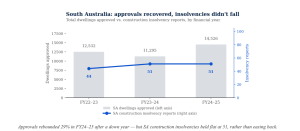
A rising market rewards discipline more than it removes the need for it. Builders who use the upswing to firm up margins, price realistically, and manage capacity are converting growth into a more durable business. Those who simply take on more work at the same thin margins are running faster in the same direction — which isn’t automatically the same as running toward safety.
A rising market doesn’t make a business safer by itself. It makes the difference between a disciplined builder and a stretched one easier to see — for everyone paying attention.
What Good Lending Actually Looks Like
Construction lending, done well, isn’t just financing a building — it’s backing a company through the ordinary, manageable gap between when it’s paid and when its own subcontractors and suppliers need to be paid. Most builders navigate that gap successfully, most of the time. The ones who do it best tend to treat their financial position as something to check in on regularly, not just something to present at drawdown — and the lenders who do best make that an ongoing conversation rather than a one-off gate.
The best construction lending relationships aren’t the ones with the strictest gate at the start. They’re the ones with an open door the whole way through.
None of this is a reason for caution about the sector or the current upswing — both are, on balance, good news. It’s a case for treating the visible signals covered here as useful early information, not as something to look past while the numbers are strong. Caught early, they’re a chance to help a good builder stay one. Caught late, they’re a much harder conversation for everyone.
Sources: Australian Bureau of Statistics, Building Approvals, Australia (time series to May 2026); Australian Securities & Investments Commission, Insolvency Statistics Series 3.1 & 3.2, FY2022–23 to FY2024–25.